English
 Français
 عربى
Home / News / Industry News / Acetate Fabric Evening Wear: Properties, Benefits, and Care for Designers
Industry News

Content
Evening wear is unforgiving territory for a fabric. Garments are photographed under harsh light, worn for hours at a stretch, and judged as much on how they move as on how they fit. Acetate has held a place in formal fashion for nearly a century, prized for a liquid drape and a soft, pearl-like sheen that reads as luxury under ballroom lighting and on camera alike.
For designers, product developers, and sourcing buyers, however, acetate is not a simple story. It brings genuine strengths to gowns, cocktail dresses, and evening separates, along with real limitations around heat, moisture, and abrasion. This guide explains what acetate is, why it performs so well in formal settings, how it compares with the usual alternatives, which constructions suit which silhouettes, and what to confirm with a supplier before committing a collection to it.
Acetate is a semi-synthetic fiber built from purified cellulose, most often derived from wood pulp. During manufacturing, the cellulose is reacted with acetic acid in a controlled process, dissolved into a spinning solution, and extruded into fine filament yarns. Those yarns are woven or knitted into fabrics with a naturally smooth surface and a distinctive soft luster that separates them from ordinary synthetics.
Because its core is plant-based cellulose, acetate behaves in some ways like a natural fiber, yet it is produced with the consistency of a manufactured one. Mills can control luster, hand feel, and fabric width with precision, which is one reason it became a staple of formal fashion and quality linings throughout the twentieth century.
Two variants matter to buyers. Diacetate, the standard form in apparel, offers a soft sheen and fluid hand but is sensitive to heat and common solvents. Triacetate tolerates heat better and presses more easily, though it is less widely available. In evening wear, much of what mills supply today is blended, most often with polyester or viscose and sometimes with a small share of elastane, pairing the surface beauty of acetate with added durability and dimensional stability.
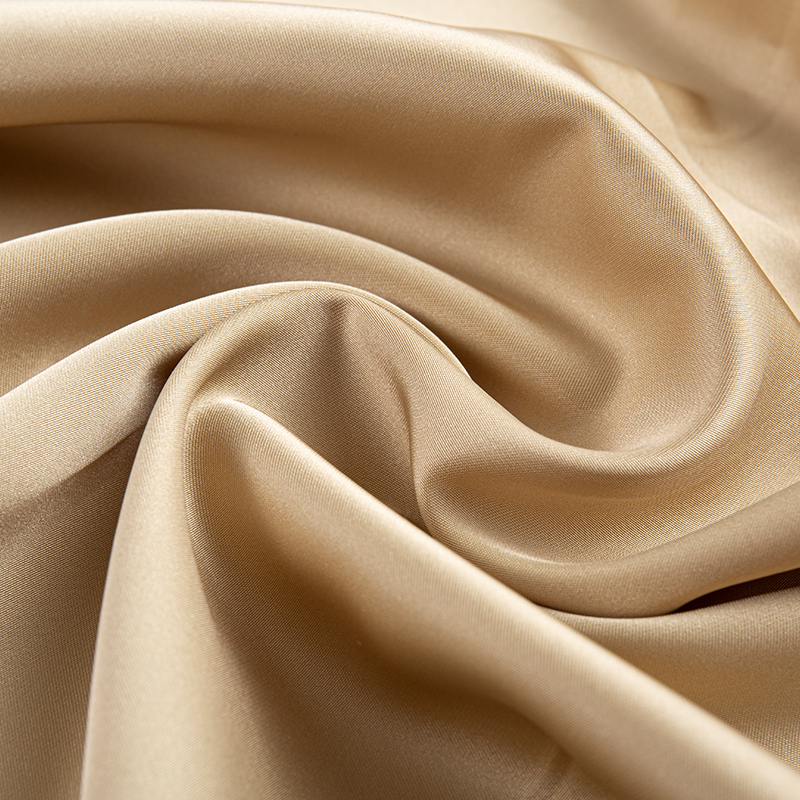
The acetate filament has a flattened, irregular cross-section that scatters reflected light softly rather than bouncing it back in a hard glare. On a finished gown this reads as a warm, pearl-like glow instead of the mirror-bright shine associated with some synthetic satins. The effect is especially valuable for evening wear, where a single garment may be seen under spotlights, camera flashes, and candlelight within the same night, and a harsh shine flatters none of them.
Drape is where acetate quietly wins many comparisons. The fiber is lightweight, and fabrics built from it fall close to the body, swing easily, and recover from folding without the stiff creases that plague some alternatives. For bias-cut skirts, fluid columns, and flowing wraps, this movement is central to the silhouette rather than a bonus.
Acetate accepts dyes deeply, producing rich color saturation that holds up on stage and on camera. Jewel tones, deep blacks, and midnight blues, the backbone of evening palettes, come out intense and even, which is difficult to achieve on fibers with poorer dye affinity. For collections built around a signature shade, this consistency matters commercially.
A fully lined formal gown in acetate satin feels noticeably lighter than the same garment built in heavier synthetics, an advantage guests appreciate during ceremonies and receptions that run for hours.
No fabric is right for every design, so the practical question is how acetate stacks up against the fibers it competes with in formal wear. The table below summarizes the differences that influence silhouette choice, cost planning, and care labeling.
| Characteristic | Acetate | Silk | Polyester satin | Viscose |
|---|---|---|---|---|
| Surface sheen | Soft, pearl-like | Natural, rich | Bright, glossy | Soft, low-key |
| Drape | Fluid, close fit | Fluid, resilient | Stiffer, springy | Good, relaxes |
| Breathability | Moderate | High | Low | High |
| Heat tolerance | Low | Moderate | Moderate to high | Moderate |
| Typical care | Dry clean | Dry clean | Machine wash | Gentle wash |
| Relative cost | Low to moderate | High | Low | Low to moderate |
Polyester delivers durability, easy care, and low cost, but its shine can look harsh under direct lighting and it traps heat in warm venues. Silk remains the reference point for drape and luster, yet its price places it out of reach for many lines. Viscose drapes and breathes well but loses strength when wet and creases readily. Acetate occupies a deliberate middle ground: much of the visual and tactile appeal of silk at a cost position that works for volume production, provided its care needs are respected. For a wider view of fiber selection, our guide to choosing the right natural fiber fabric covers the decision framework in more depth.
Acetate is less a single fabric than a family of constructions, and the choice of weave determines which garments it serves best.
Column gowns Cocktail dresses Evening jackets Wraps and shawls
A five-end satin has a long float structure that produces a smooth, high-luster face, ideal for column gowns and bias skirts where light should travel across the surface. Double-sided satin adds further versatility, giving wraps, shawls, and reversible details a finished face on both sides of the cloth.
 Acetate Satin Fabric for Gowns and Bias-Cut SkirtsWith its five-end satin weave, this 61% acetate, 39% polyester fabric offers a smooth, lustrous face and fluid drape, suiting column gowns, bias skirts, and eveningwear where light should travel across the surface.View Product →
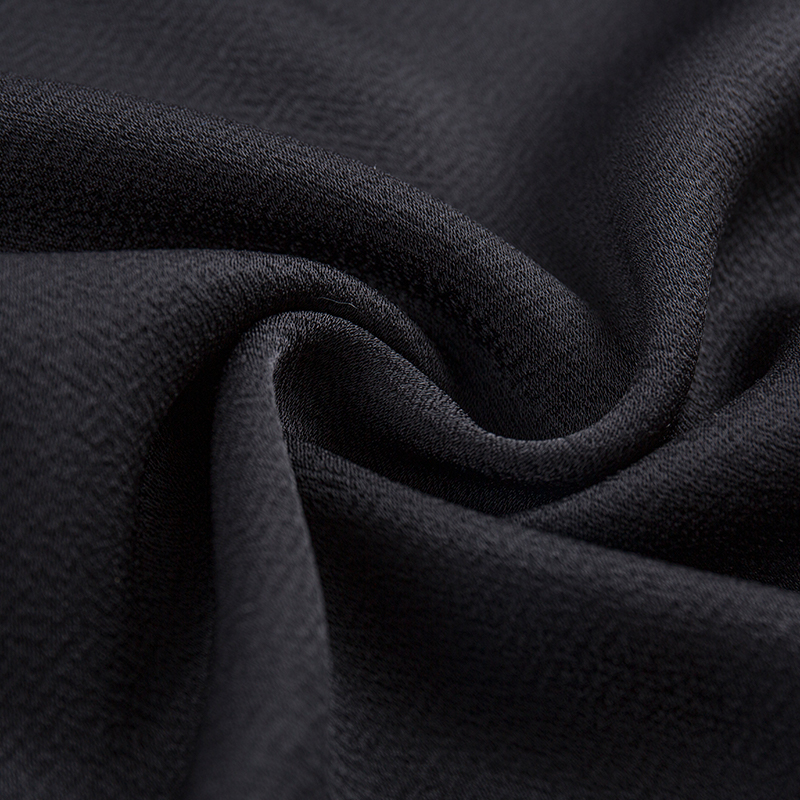
Crepe constructions, including willow crepe and double-faced crepe, exchange shine for a softly grained texture. They resist showing everyday wear, photograph with a matte sophistication, and hold pleats and gathered details well, which suits cocktail dresses and event separates.
 Imitation Acetate Double-Sided Crepe FabricThis 100% polyester crepe presents a fine matte texture on both sides with a 215 GSM drape, matching the crepe section's note that grained finishes hold pleats and gather details for cocktail dresses and event separates.View Product →
Satin constructions built with four-way stretch allow fitted bodices, mermaid cuts, and wrap styles to hold the body closely while still permitting movement on the dance floor. The elasticity comes from the yarn and structure, so the surface keeps the appearance of a classic satin.
 Four-Way Stretch Satin Fabric for Fitted SilhouettesWoven from 85% polyester and 15% spandex, this 180 GSM satin keeps a classic lustrous surface while stretching in all directions, ideal for fitted bodices, mermaid cuts, and wrap styles that allow movement.View Product →
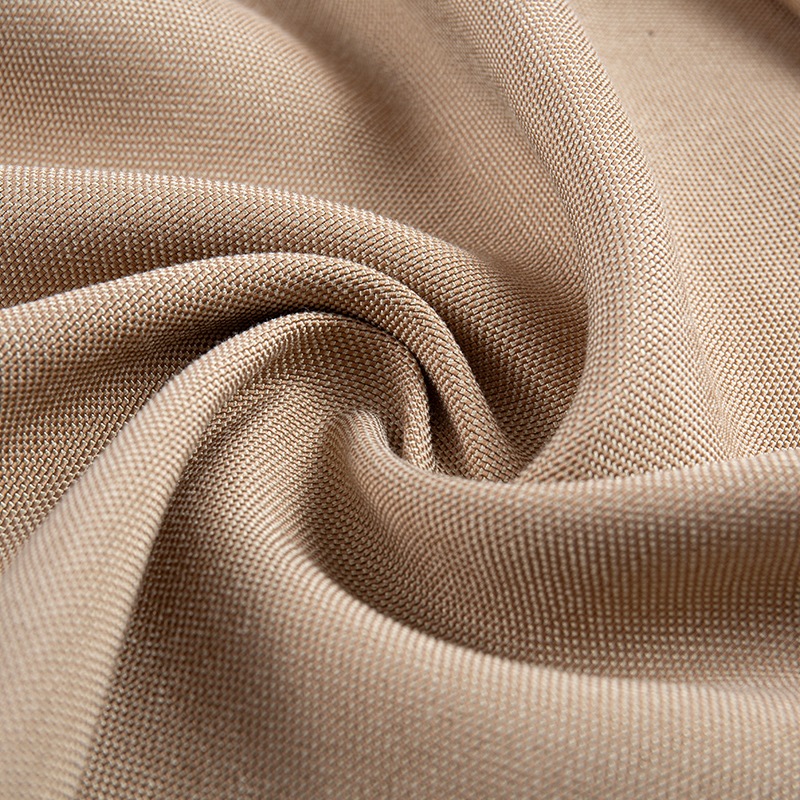
Blends deserve deliberate selection. An acetate-viscose mix leans into drape and breathability for summer events, while acetate-polyester builds add wrinkle recovery and easier care for occasion dresses that will be worn repeatedly. Linen-feel double-layer fabrics bring a crisp, matte option for spring evening jackets and structured separates when the brief calls for coverage without weight.
| Construction | Surface character | Best suited to |
|---|---|---|
| Five-end satin | Smooth, lustrous face | Column gowns, bias skirts |
| Double-sided satin | Reversible sheen | Wraps, shawls, stoles |
| Crepe and willow crepe | Matte, fine grain | Cocktail dresses, pleats |
| Satin, four-way stretch | Glossy with elasticity | Fitted bodices, mermaid cuts |
| Linen-feel double layer | Crisp, matte, structured | Evening jackets, separates |
Because acetate has specific sensitivities, a handful of construction decisions protect both the garment and the wearer's experience. None of them are expensive on their own; together they separate a professional result from a disappointing one.
Finally, sample the finished garment under warm and cool lighting before approving the style. A sheen that looks elegant in daylight can shift dramatically on a stage, and physical sampling remains the only reliable way to know how a color and surface will behave.
Acetate's main weaknesses are heat, certain solvents, and rough handling when wet. Care instructions should therefore be built into the garment from the start, and buyers should confirm that a proposed construction can survive realistic care routines, not just laboratory ones.
Imitation acetate, engineered from polyester to reproduce the same hand and sheen, tolerates heat and laundering better than true acetate. This is why many mills recommend it for pieces expected to see frequent wear, rental cycles, or less careful home care, while true acetate remains the choice where authenticity of luster is the top priority.
Whether evaluating a mill or a trading partner, a structured set of questions separates fabrics that merely photograph well from fabrics that survive production and wear. Before approving an acetate or imitation acetate quality, confirm the following points in writing.
Reviewing a supplier's full range also helps. Comparing qualities side by side within an acetate and imitation acetate fabric category makes it far easier to match construction, weight, and finish to each garment type in a line.
Acetate starts from a renewable, plant-based raw material, and cellulose-based fibers biodegrade under suitable conditions, which supports credible sustainability narratives in formal wear. The manufacturing process, however, involves solvents whose recovery and reuse vary from mill to mill, so brands making environmental claims should ask about process controls rather than relying on fiber origin alone. Honest care messaging extends garment life too, which is often the largest sustainability lever in evening wear, where garments are worn infrequently and preserved carefully between occasions.
Yes, when the design plays to its strengths. Acetate offers silk-like sheen, fluid drape, and deep color at an accessible cost, which explains its long history in formal wear. Its heat and moisture sensitivity simply call for realistic care planning and clear garment labeling.
It creases more readily than polyester but recovers better than linen and many other cellulosics in fluid constructions. Crepe and double-layer builds hide creasing well, while smooth satins show it more. Hanging the garment in a steamy bathroom or steaming gently from a distance usually relaxes light creases.
Most true acetate constructions should be dry cleaned or hand washed briefly in cool water. Polyester-based imitation acetate is generally more wash-tolerant, so always follow the garment's care label rather than the fiber name alone.
True acetate is a regenerated cellulose fiber made from wood pulp. Imitation acetate is a polyester filament engineered to mimic acetate's sheen and hand, offering better heat tolerance and easier care at a lower cost. Both are widely used in evening wear collections today.
A satin with four-way stretch supports close-fitting bodices and mermaid silhouettes while preserving a glossy surface. For a fluid, unstructured column dress, a five-end satin without stretch gives the cleanest line and the most graceful movement.