English
 Français
 عربى
عربىIndustry News
Acetate satin fabric has long held a distinct position in the textile industry, prized for its lustrous surface and fluid drape. While often compared to silk in appearance, its unique composition and performance characteristics set it apart.
Composition: The Semi-Synthetic Origin
Acetate satin fabric belongs to the family of regenerated fibers. It is derived from cellulose, typically sourced from wood pulp or cotton linters. Through a chemical process involving acetylation, cellulose is converted into cellulose acetate, which is then dissolved, extruded through spinnerets, and solidified into filaments. These filaments are subsequently twisted, processed, and woven into a satin structure.
Unlike fully synthetic fibers such as polyester or nylon, acetate retains a natural affinity to moisture and exhibits lower thermal plasticity. However, unlike true cellulosics like viscose, acetate satin fabric is less absorbent and melts under high heat rather than burning. This semi-synthetic nature gives it a hybrid behavior: the gloss and smoothness of a luxury textile, combined with certain manufacturing economies.
| Property | Acetate Satin Fabric |
|---|---|
| Fiber origin | Purified cellulose (wood/cotton) |
| Chemical type | Cellulose acetate (ester) |
| Moisture regain | ~6% (moderate) |
| Heat sensitivity | Melts at 200–230°C |
| Static tendency | Low to moderate |
Texture: Visual and Tactile Profile
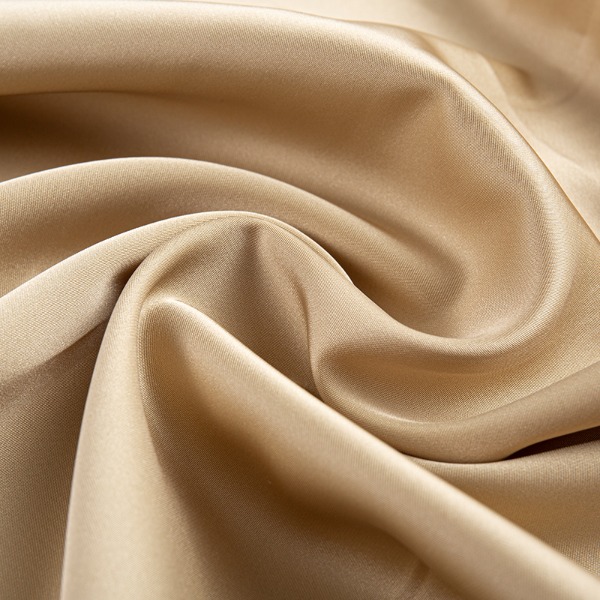
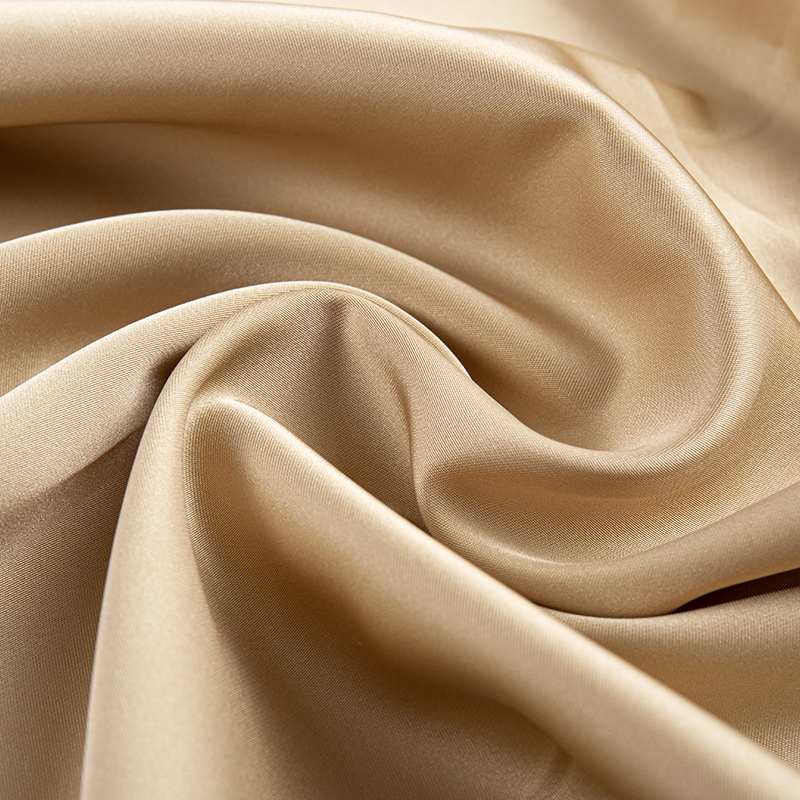
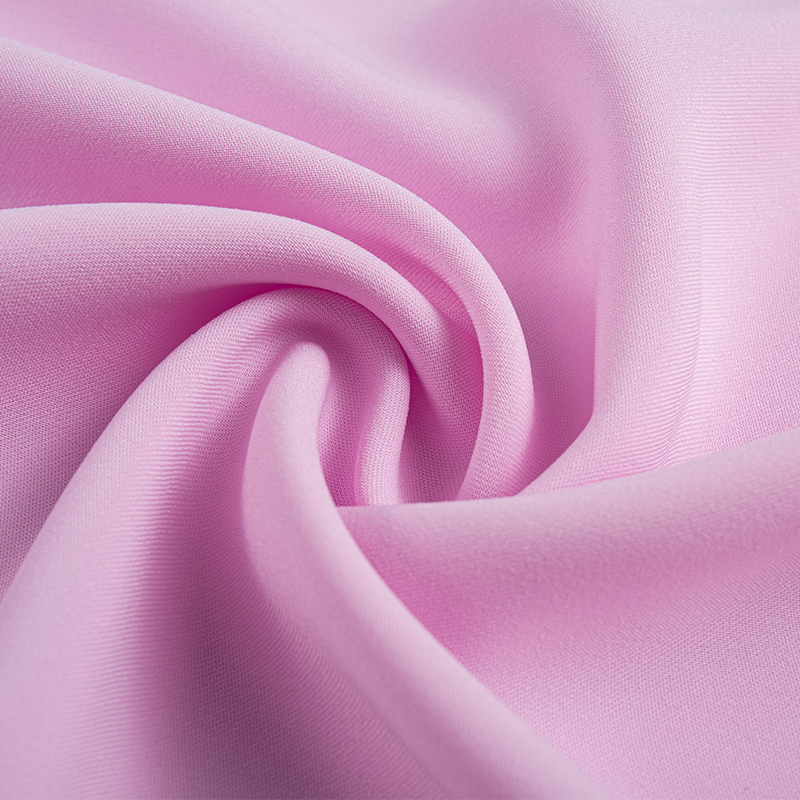
The term “satin” refers to a weave structure, not a fiber. In acetate satin fabric, the satin weave uses floating warp or weft yarns to create a smooth, unbroken surface that reflects light directionally. This gives the fabric its characteristic high sheen on the face side, while the back remains duller and slightly textured.
When touched, acetate satin fabric feels cool, slick, and exceptionally smooth. It does not have the natural microscopic scales of silk, so the surface is more uniform. Compared to polyester satin, acetate satin fabric has a softer hand and lower surface friction, but it is also less resilient. Notably, it lacks the elastic recovery of nylon or spandex-blended materials.
Key textural descriptors for acetate satin fabric include:
- Glossy but not plasticky – The luster is deep, closer to pearl than mirror.
- Fluid drape – Falls in soft, continuous curves without stiffness.
- Lightweight – Typically 60–100 gsm for linings, 150–220 gsm for apparel.
- Cold-to-touch sensation – Similar to silk during initial contact.
Performance in Use: Strengths and Limitations
Acetate satin fabric is widely employed for linings, lingerie, blouses, dresses, scarves, and drapery. Its performance profile balances aesthetics against practicality. Below is a systematic evaluation of key performance indicators.
Draping and Aesthetic Performance
The most celebrated quality of acetate satin fabric is its draping behavior. Due to the low torsional rigidity of acetate filaments, the fabric forms soft, narrow folds. This makes it ideal for bias-cut garments and flowing silhouettes. Color yield is high, with printed acetate satin fabric displaying sharp edges and rich saturation due to the fiber’s affinity for disperse dyes.
Durability and Abrasion Resistance
In terms of longevity, acetate satin fabric is moderate. Dry abrasion resistance is acceptable for occasional wear but falls below that of polyester satin or nylon taffeta. Repeated flexing can lead to yarn splitting, especially along fold lines. Care must be taken to avoid sharp creasing. Seam slippage is a known issue; thus, seams often require shorter stitch lengths or French seams when used in unlined garments.
Moisture Management and Breathability
Acetate satin fabric does not trap body heat as severely as non-porous synthetics. With a moisture regain around 6%, it is more breathable than polyester but less so than cotton or viscose. Perspiration absorption is moderate, but the fabric can become uncomfortable if fully saturated because wet acetate satin fabric loses strength temporarily and dries slowly.
Heat and Chemical Sensitivity
This is the most critical limitation. Acetate satin fabric melts under high heat—ironing must be done with a cool iron (below 150°C) or using a pressing cloth. Dry cleaning is often recommended for structured garments, but many modern acetate satin fabrics are labeled as hand-wash cold with mild detergent. Acetone (common in nail polish remover) dissolves cellulose acetate instantly; contact causes permanent damage.
Wrinkle Recovery and Shrinkage
One practical advantage: acetate satin fabric has good wrinkle recovery in lightweight constructions, better than viscose satin. It holds a crease poorly, which is beneficial for travel garments but undesirable for pleats. Shrinkage is typically under 2% when washed in cold water, but high temperatures can cause distortion.
Comparison with Other Satin Weave Fabrics
To position acetate satin fabric accurately, a comparative overview (without brand or company references) is useful. The table below contrasts it against common satin-weave textiles using generic fiber types.
| Property | Acetate Satin Fabric | Polyester Satin | Viscose Satin | Silk Satin (Mulberry) |
|---|---|---|---|---|
| Luster | Deep, pearl-like | Bright, harsh | Subtle, soft | Natural, irregular |
| Drape | Excellent, fluid | Stiffer, more memory | Good, heavier | Superior |
| Breathability | Moderate | Low | High | High |
| Heat resistance | Poor (melts) | Good (melts higher) | Poor (burns) | Good (burns) |
| Cost | Mid-range | Low to mid | Mid-range | High |
| Static cling | Low | High | Moderate | Very low |
| Resistance to pilling | Low | Medium | Low | High |
This table shows that acetate satin fabric occupies a middle ground—affordable, beautiful drape, but requiring careful handling.
Applications and End-Uses
Acetate satin fabric appears in several product categories:
- Apparel linings – Jackets, coats, and skirts benefit from the low-friction surface that allows outer fabrics to slide without pulling.
- Lingerie and sleepwear – The smooth, non-irritating surface is suitable for camisoles and slips.
- Evening wear – Bias-cut dresses and wide-leg trousers exploit the drape.
- Scarves and accessories – Print definition and light weight are advantageous.
- Home textiles – Decorative cushion covers, drapery linings, and bed skirt overlays use acetate satin fabric for sheen without high cost.
In each application, designers compensate for low tensile strength by using interlinings or limiting stress points.
Care and Maintenance Guidelines
Preserving acetate satin fabric requires discipline. The following care principles are derived from generic textile science:
Washing – Hand wash in cold water (below 30°C) with mild detergent. Do not wring or twist. Machine washing is not recommended unless explicitly stated on a generic care label.
Drying – Roll in a towel to remove excess water, then lay flat away from direct heat or sunlight. Tumble drying causes melting and shrinkage.
Ironing – Set iron to synthetic or low (max 110°C). Iron on the reverse side while the fabric is slightly damp, or use a pressing cloth.
Stain removal – Blot immediately. Avoid acetone-based solvents; use water or dry-cleaning fluid only in a well-ventilated area.
Storage – Hang or fold loosely. Avoid plastic bags that trap moisture. Use acid-free tissue paper in folds to prevent crease lines.
Failure to follow these steps often results in irreversible damage: bubbling, fusing, brittleness, or dye bleeding.
Conclusion
Acetate satin fabric offers a compelling balance of visual elegance and moderate practicality. Its semi-synthetic composition provides a silk-like hand and deep luster at a more accessible price point, while its satin weave structure optimizes light reflection and draping fluidity. However, performance trade-offs—low heat tolerance, sensitivity to acetone, and moderate abrasion resistance—demand informed handling. When used within its limitations, acetate satin fabric remains a valuable material for lightweight apparel, linings, and decorative textiles. Understanding its composition, texture, and performance allows designers, manufacturers, and consumers to make technically sound decisions without reliance on proprietary or branded inputs.